March 17, 2026
Google Search is no longer just a list of ‘blue links.’ With the integration of new features like AI Overviews and AI Mode, Google has transformed into a Curated Answer Engine (a summary-based answer provider). This fundamental shift challenges every traditional SEO strategy we know.
According to Neil Patel’s analysis, the goal is no longer just to secure the top spot in search rankings. Instead, the objective is to establish your brand as a ‘Trusted Source’ in the eyes of Google AI through Generative Engine Optimization (GEO). The new target is to ensure your content is directly cited by Google AI in its summarized answers. Today, building Brand Mentions and long-term Mind Share is more critical than generating immediate Clicks.
1. How Google AI Overviews and GEO Work
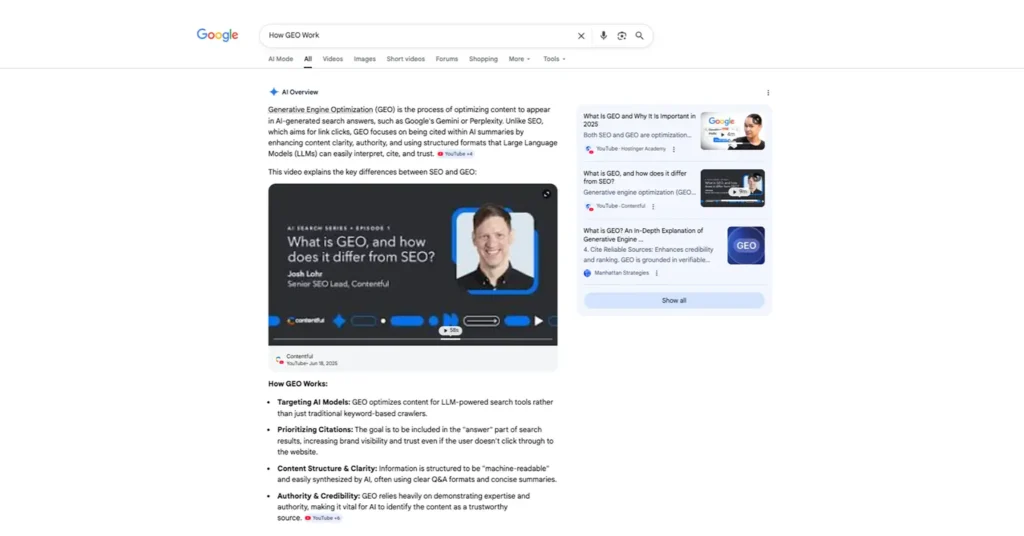
Google AI Overviews and AI Mode are search features where users receive direct summaries, answers, and recommendations collected and compiled by AI from multiple sources. These answers are not generated based on keyword matching alone; they are created by analyzing User Intent, Context, and related Entities (people, organizations, places, concepts). The sources used to generate the answer are cited below the summary.
What is GEO (Generative Engine Optimization)?
GEO is the strategy of increasing a brand’s presence and Citations in AI-based search results. It moves beyond simple Keyword Matching to prioritize:
- User Intent & Question-Based Content: creating clear, direct answers to what the user is actually asking.
- Authority & Trust: Proving deep knowledge, experience, and reliability on a specific topic.
- Extractable Format: Structuring content so that AI can easily extract and cite small snippets of information.
Read also: What is AEO and How to win AI powered search
2. The E-E-A-T Strategy
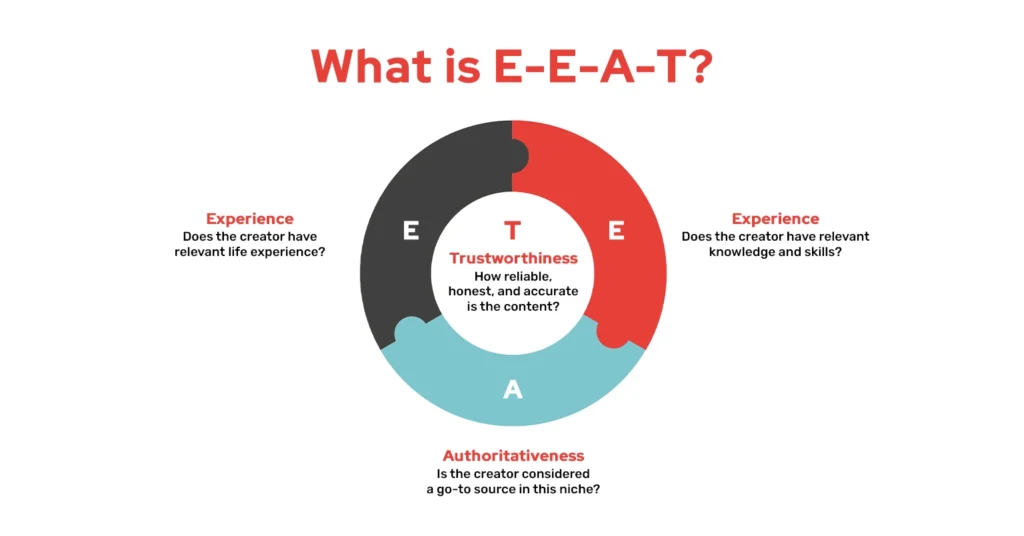
Google AI will only cite you when it recognizes you as a Knowledge Entity backed by strong Brand Signals. The foundation of this is Google’s Quality Rater Guidelines framework: E-E-A-T.
A. E-E-A-T (Experience, Expertise, Authoritativeness, Trustworthiness)
|
Metric |
Simple Explanation |
Action Plan |
|
Experience |
Have you actually done it? |
Include case studies, proprietary data, and ‘Before-After’ examples. |
|
Expertise |
Do you know the subject? |
Display the author/expert’s degrees, certificates, qualifications, photos, and bio clearly. |
|
Authoritativeness |
Do others value you? |
Get media/PR coverage, blog mentions, backlinks, and industry awards. |
|
Trustworthiness |
Do people trust you? |
Use citations, accurate sources, regular updates, and clear SOPs (Standard Operating Procedures). |
B. Boosting Brand Signals
To build credibility in the eyes of AI, you must increase your brand’s online Mentions and popularity.
- Public Relations (PR): Get your brand name, work, or expert opinion published in media outlets or large platforms.
- Reviews & Testimonials: Collect Positive Mentions and reviews on Google Business Profile, Facebook, and other platforms.
- Consistency: Keep your Name, Address, and Phone Number (NAP) identical across all platforms.
3. Semantic Positioning: Optimizing for Meaning
Semantic Positioning means optimizing content not just for a few keywords, but based on the complete Topic, User Intent, and related Entities. This enables AI and search engines to accurately understand the content’s essence, depth, and authority.
A. Topic Clusters and Pillar Content
Create a core “Pillar Content” piece on a main subject and link all related sub-topics around it as a “Topic Cluster” via internal linking.
Example:
- Pillar: “2025 Digital Marketing Guide”;
- Cluster: “New AI SEO Tools”, “Video Marketing Strategies”, “What is GEO?”.
- Result: Google AI identifies your site as an Entity Authority on that specific subject.
B. Entity-Based Writing
Avoid ambiguous words in your content. Instead, specifically name Entities (Persons, Places, Things, Diseases, or Solutions).
Example:
-
- Wrong: “This tool analyzes data.”
- Right: “Google Search Console analyzes Web Vitals and Core Web Vitals data.”
C. User Intent Analysis
Determine the intent Informational, Commercial, Navigational, or Transactional and format the content to match that specific intent.
4. Multi-Format Media & Cross-Optimization
Google now pulls not just text, but Video, Images, and Charts into AI Overviews. Therefore, your content must be multi-format friendly.
A. Visual Content Optimization for AI
- Transcripts & Subtitles: Add full text transcripts for every video, podcast, or webinar on your website or YouTube. This helps AI “read” your audio content.
- Schema Markup:
-
- Use Video Object and Clip schema for videos.
- Use Image Object schema for images and infographics.
- Alt Text & Filenames: Add keywords and entities to the Alt Text and Filenames of infographics, charts, or images.
B. Cross-Optimization (Video, Shorts, Podcast)
Publish the same content across different platforms using the same message and keywords.
- Example: For a main topic like “SEO for SaaS,” create a Blog Post, a YouTube Video, a 30-second YouTube Short, and an Audio Podcast.
- Result: Google AI understands that you are providing consistent and deep content on this subject across all mediums.
5. Competitor Reverse Engineering: Stealing Success Secrets
“Reverse engineering competitors’ successful keywords” means analyzing the keywords where your competitors are getting cited or ranked well by Google AI, and then creating content that is better, deeper, and more AI-friendly than theirs.
The Strategy:
- AI Citation Analysis: Identify which pages and keywords your competitors are being cited for in Google AI Overviews.
- Identify Content Gaps: Find what is missing in their content that you can add (e.g., Case Studies, Proprietary Data, Infographics, FAQs).
- Create Superior Content: Establish your Entity Authority by creating content that is deeper, contains updated information, includes clear SOPs, and utilizes multimedia.
6. Brand Equity & Mind Share: Customer Retention Strategies
The goal of GEO is not just clicks, but to establish your brand as the “Default Solution” in the consumer’s mind.
A. Brand Equity
- Long-term Trust: Build a relationship of trust and loyalty with customers by providing consistent, high-quality, and helpful content.
- The Trust Cycle: Create a cycle of confidence by solving users’ real problems and collecting positive reviews and social proof.
B. Mind Share
-
When someone thinks of a particular product or solution, the first brand name that comes to mind is Mind Share. (e.g., Search Engine = Google).
-
How to Build It: Provide the best and deepest content consistently within a specific Niche. Position your brand as the Primary Expert on that topic.
7. KPIs & Monitoring: Ways to Measure Success in AI
-
Classic SEO metrics (like CTR or Ranking positions) are not enough for GEO. We must now track AI-based metrics.
KPI (Key Performance Indicator)
Explanation
Strategic Implication
Citation Count
How many times brand content is cited in AI Overviews.
Strengthen the E-E-A-T of your content.
AI Visibility Rate
The percentage of your target keywords where your brand is visible in AI results.
Increase Topic Clusters and keyword coverage.
Share of Voice
Your brand’s mention rate compared to competitors.
Increase Brand Signals and Mind Share.
Sentiment
The tone of the brand in AI answers (Positive, Negative, Neutral).
Focus on Brand Monitoring and Reputation Management.
Conclusion
The rise of Google AI Overviews marks a historic turning point in digital marketing. To survive here, one needs not just speed or technical SEO, but a shift in Mindset.
Build your brand in such a way that both Google’s AI and humans view you as a Trusted, Authoritative, and Memorable source. In this new world of GEO, the winner is the one who becomes “The most trusted information provider. ”
With over 13 years of digital strategy expertise and a strong understanding of AI-first content ecosystems, Marketing Bee is ready to help your brand lead in the AEO space.
Explore this content with AI:
Recent Post
Google’s AI Revolution: How AI Overview and AI Mode Are Reshaping SEO
Alif Meherab
April 1, 2026
How to Train Google’s AI to Send You Customers
Alif Meherab
March 17, 2026
Answer Engine Optimization (AEO): How to Win in AI Powered Search
Alif Meherab
December 30, 2025
From Tiger to Heart: Banglalink’s Rebranding Decision People Question, But Might Be Brilliant
Alif Meherab
December 7, 2025

Alif Meherab is a digital strategist and front-end developer specializing in netnographic communications, brand positioning, and neuromarketing tactics. With expertise in UI design, digital marketing strategy, and promotional storytelling, Alif helps brands connect with audiences through impactful copy, engaging visuals, and retention-driven social media campaigns.
- Alif Meherab
- Alif Meherab
- Alif Meherab
- Alif Meherab
- Alif Meherab