
May 20, 2026
Table of Contents
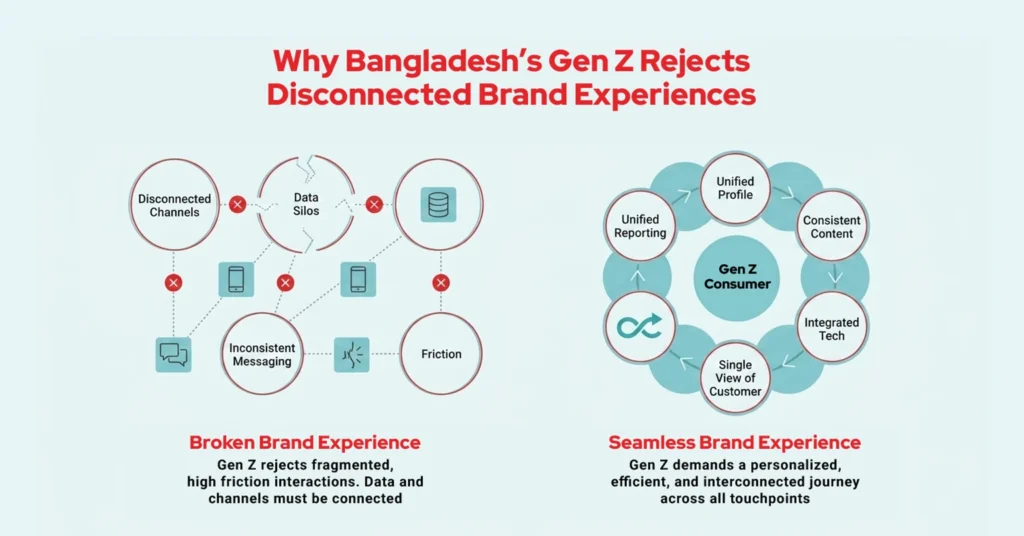
ToggleA university student in Dhaka discovered a clothing brand on TikTok on a Tuesday afternoon. She screenshots the item, saves it to her Instagram collection, sends the link to a friend on Messenger, then Googles the brand name that evening. She visits the website on her laptop, reads two reviews, and decides to visit the physical store before committing.
Three days later, she walks in. The staff knows nothing about the sale running on the brand’s Facebook page. The Instagram bio links to a page that has been untouched for four months. The in-store price does not match the website.
She still buys the item, but she never follows the brand again.
This is how Bangladesh’s Gen Z moves through brands today. The brand did not lose her because the product was wrong or the ad was bad. It lost her because the experience was broken. Now, that is an omnichannel problem.
What Omnichannel Actually Is
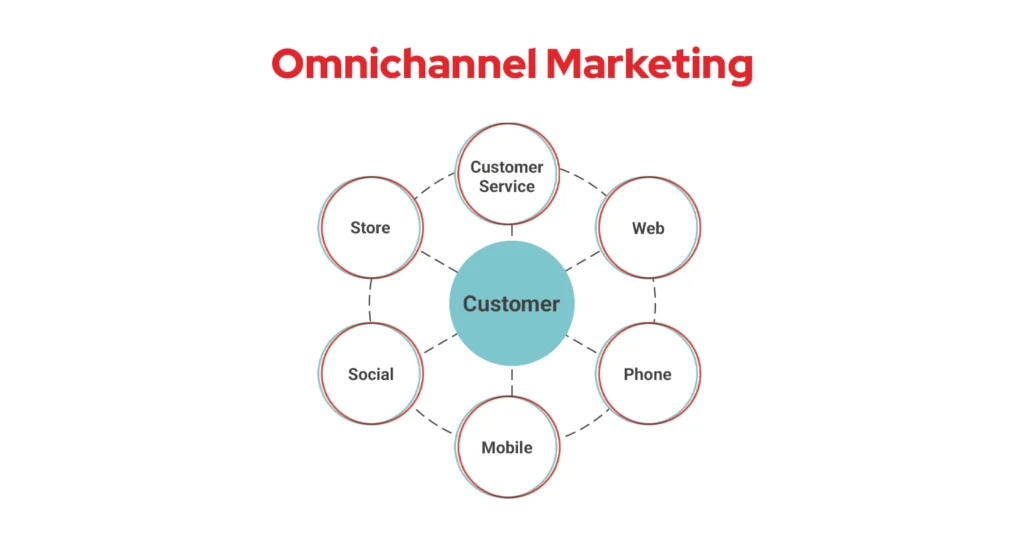
Omnichannel marketing is one unified customer experience running consistently across every channel a brand occupies. Same voice on Facebook. Same offer on the website and in the WhatsApp broadcast. Same quality of engagement from the Instagram DM as from the in-store counter. Every platform connects to every other platform, and every interaction builds on the one before it.
It is not about being everywhere. Almost every brand in Bangladesh is “everywhere” in the loose sense. It is about being coherent everywhere, which is far rarer and far more valuable.
The stakes for getting this right keep rising. Social media user identities in Bangladesh increased by 7.1 million, a 13.3% rise, between early 2024 and the start of 2025. Gen Z constitutes roughly 40% of Bangladesh’s total population, approximately 65 million individuals aged between 13 and 28 as of 2025. This is not a niche demographic to plan for eventually. This is the market, right now.
Omnichannel vs. Multichannel: The Confusion Costing Real Money
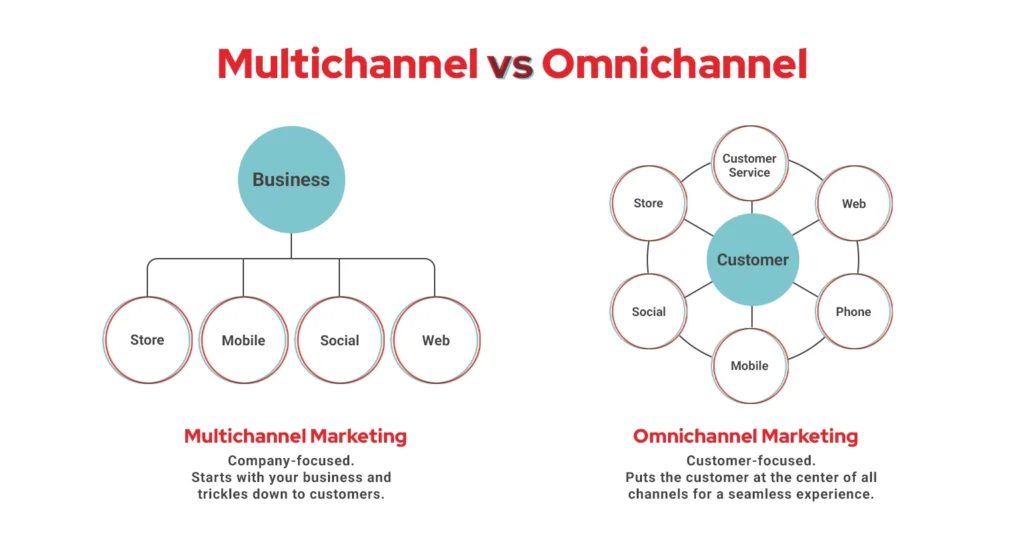
Multichannel means being present on multiple platforms. A Facebook page, an Instagram account, a website, a WhatsApp Business number. You are posting. You think you are marketing.
Omnichannel means those channels are connected. A customer who clicks an Instagram ad and lands on your website sees the same promotion, not one that expired last month. A customer who messages your Facebook page with a complaint is not redirected to a hotline. The conversation continues where it left off.
That difference is entirely structural.
Multichannel broadcasts to people. Omnichannel builds a relationship across touchpoints. For Gen Z, that distinction is everything. According to NielsenIQ, Gen Z is the most omnichannel generation, regularly interacting across social commerce platforms, direct-to-consumer apps, loyalty apps, and physical stores, often within a single purchase journey. A 2025 Retail Dive study found that 74% of Gen Z shoppers make purchases on their smartphones before visiting physical stores.
These are not separate events. They are one connected decision made across five different interfaces. A brand running those five interfaces with five different tones and five different offers is not meeting this customer. It is losing her to a competitor who figured out the thread.
How AI Actually Powers Omnichannel Marketing (And Why Gen Z in Bangladesh Demands It)
Most brands in Bangladesh understand that they need AI. Very few understand what AI is actually doing for the brands that are winning. Yeah, AI can write captions and generate thumbnails. But that’s not the whole point.
At the omnichannel level, AI is the connective tissue that makes a fragmented, multi-platform presence feel like a single, intelligent brand.
Here is what that looks like in practice.
Knowing Where the Customer Is Before She Tells You
AI in omnichannel marketing unifies and analyzes data about customers across platforms to predict which channels they are most likely to convert on. For a Bangladeshi brand running campaigns across Facebook, TikTok, and a website simultaneously, that means the system is watching, learning, and adjusting the next touchpoint based on what happened in the last one. Not next week. In real time.
According to a Gartner report, companies using AI-driven orchestration see a 30% reduction in cart abandonment and a 15% increase in average order value. Those numbers come from removing friction between channels, not from running better ads.
Sentiment Analysis: Reading the Room Across Every Platform
Gen Z does not complain in formal feedback forms. They post. They comment. They move on. AI-powered sentiment analysis tools track the emotional tone of those interactions across Facebook, TikTok, comment sections, and WhatsApp, surfacing how an audience actually feels about a campaign long before a brand’s internal team figures it out.
Sentiment analysis uses Natural Language Processing and Machine Learning to interpret emotional tone in customer interactions across channels, going beyond tagging feedback as positive or negative to uncover the reasoning behind each reaction. For brands targeting Bangladesh’s Gen Z, where trust is earned locally and lost publicly, catching a negative sentiment spike on TikTok before it becomes a Facebook pile-on is the difference between a recoverable moment and a brand crisis.
Personalization That Actually Means Something
There is a version of personalization that insults the customer. Sending a broadcast message to 40,000 people that begins with “Hey [First Name]” is not personalization. It is a mail merge.
Real AI personalization tracks what a customer browsed on your website and follows up with messaging on their next active channel referencing exactly that behaviour. When a customer views a product online but leaves the site, AI can trigger a personalized discount via email or a mobile notification, encouraging a return to complete the purchase. The MIT Annual Omnichannel Survey found that 71% of retailers are already using or planning to use AI for personalized product recommendations, making it the single most common application of AI in omnichannel retail today.
Starbucks is the clearest proof that this works at scale. The company reported more than 30 million active Rewards members in 2024, with Rewards driving roughly 57% of US company-operated sales, powered by a Deep Brew AI engine that personalizes offers across app, email, and in-store screens. The channel is not the offer. The customer’s behaviour is. That is the distinction.
The Feedback Loop That Never Stops
Every piece of content a brand publishes is a data point. AI treats it that way. AI transforms campaign management by enabling marketers to shift from reactive to predictive strategies, processing real-time behavioral data and market trends to create a comprehensive view of the target audience that allows for more precise targeting and optimization.
For Bangladesh’s Gen Z specifically, whose preferences shift fast and whose loyalty is conditional on relevance, a strategy that waits for a monthly report before adjusting is already behind. The brands that will win this audience are the ones whose campaigns are learning and correcting while they run.
At Marketing Bee, this is the distinction we keep coming back to with clients. AI is not a content shortcut. In omnichannel marketing, it is the operating system. The strategy, the voice, and the brand judgment still come from people. But the ability to execute that strategy across six platforms, in real time, for an audience that moves faster than any human team can track manually? That is what AI is actually for.
AI Does Not Create the Omnichannel Strategy. It Makes Executing It Possible.
At Marketing Bee, we hear a version of the same problem regularly. A brand has good content, reasonable reach, and no clear understanding of why conversions are not following. The answer is almost always a broken customer journey between channels. Someone sees an ad, clicks through, lands on a page that does not match the offer, and leaves. Three touchpoints, zero continuity.
This is where AI becomes genuinely useful. AI tools can track how a customer moves across platforms, identify exactly where the journey breaks down, and allow marketers to personalize communication at a scale no human team can sustain manually. The WhatsApp follow-up message after a website visit can reference what the customer actually viewed, rather than sending a generic broadcast to 50,000 contacts who last engaged on different days for completely different reasons.
When we have worked on campaigns for clients like Bangladesh Commerce Bank and Chittagong Independent University, reach was never the primary challenge. Building a coherent experience for audiences encountering the brand across multiple touchpoints in a single week was. The tone had to hold from the first Facebook post to the in-person interaction. The offer had to be consistent whether someone found it through search or through a friend’s shared story. Trust had to accumulate across every channel, not reset with each one.
AI accelerates that process. It does not replace the judgement behind it, though.
Read related article: From Tiger to Heart: Banglalink’s Rebranding Decision
The Final Take
Omnichannel is the minimum standard for any business that wants to earn and hold the attention of Bangladesh’s Gen Z right now.
The question is never whether you are on enough channels. The question is whether those channels are building the same relationship or starting from zero every single time a customer switches platforms.
At Marketing Bee, that is the distinction we work from. Being everywhere means nothing if everything you say is slightly different everywhere you say it.
FAQs
What is omnichannel marketing in simple words?
Omnichannel marketing means giving customers the same smooth experience everywhere they interact with your brand Facebook, Instagram, website, WhatsApp, or physical store. Everything feels connected instead of separate.
What is the difference between omnichannel and multichannel marketing?
Multichannel means your business is active on many platforms. Omnichannel means all those platforms work together. The customer gets one connected experience instead of different messages everywhere.
Why is omnichannel marketing important for Gen Z in Bangladesh?
Gen Z moves quickly between TikTok, Instagram, Google search, websites, and stores before buying something. If the experience feels confusing or inconsistent, they lose trust and move to another brand.
How does AI help omnichannel marketing?
AI helps brands understand customer behaviour across platforms. It can track what people click, watch, search, or buy and help businesses show the right message at the right time.
Can AI improve customer experience?
Yes. AI can personalize offers, recommend products, send reminders, and even predict where customers may lose interest. This makes the shopping experience feel faster and more relevant.
Explore this content with AI:
Recent Post
How Marketing Bee Built Dr. Masum’s Search Presence in Just 6 Months
Alif Meherab
June 23, 2026
From Followers to Customers: Targeting Gen Z Through AI-Driven Omnichannel Marketing in Bangladesh
Alif Meherab
May 20, 2026
Is Your AI Content Hurting Your SEO? Here’s the Truth Nobody’s Saying
Alif Meherab
April 21, 2026

Alif Meherab is a digital strategist and front-end developer specializing in netnographic communications, brand positioning, and neuromarketing tactics. With expertise in UI design, digital marketing strategy, and promotional storytelling, Alif helps brands connect with audiences through impactful copy, engaging visuals, and retention-driven social media campaigns.
- Alif Meherab
- Alif Meherab
- Alif Meherab
- Alif Meherab
- Alif Meherab
- Alif Meherab